1. Colour range and the retirement factor
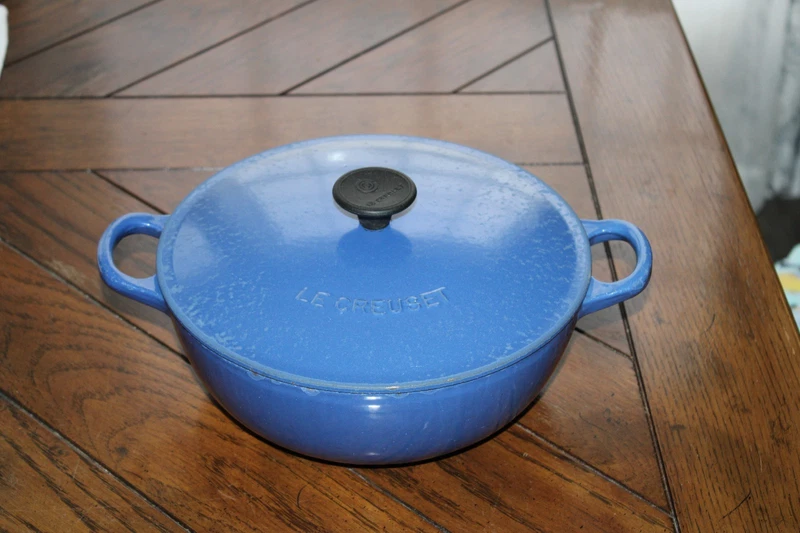
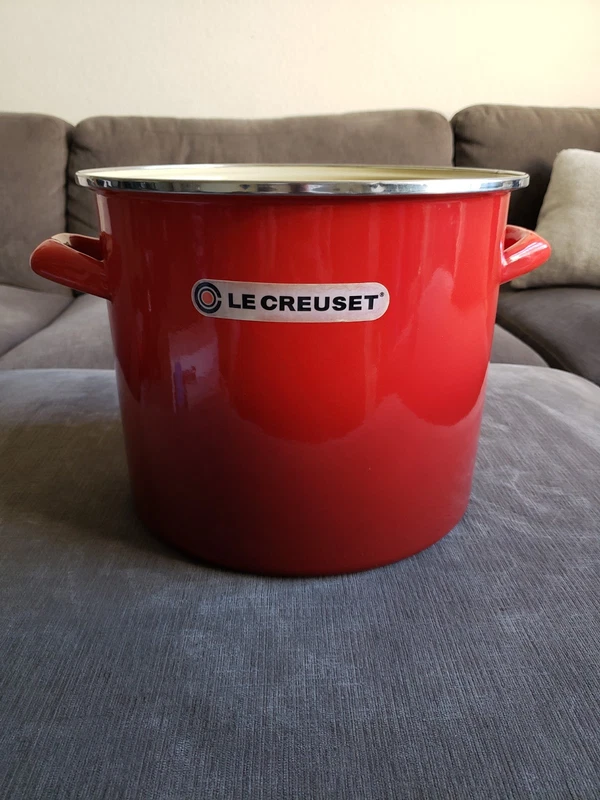
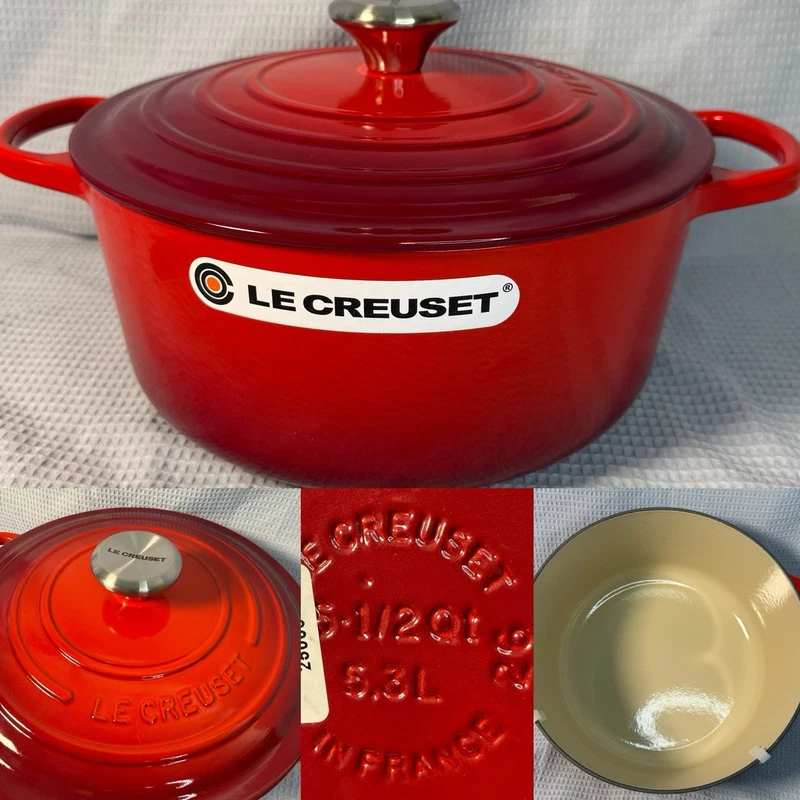
Le Creuset rotates its palette and retires colours, which is a genuine pricing fact rather than a marketing line. A new was listed at $304.99 specifically because the colour has been retired from the Le Creuset US website — the seller says so outright, and the description quotes a 4.5-quart size in a 9.5-inch pot. A new at $296.81 is described as no longer in production, and the seller adds that handmade cast iron pieces carry black spots and uneven glazing that are not defects. Staub, by contrast, keeps core colours like cerise, cherry, turquoise and cobalt in production indefinitely, which is why new Staub pieces are easier to find in a specific colour and why a retired Le Creuset colour carries a premium.
2. The lid, and self-basting geometry
This is the biggest functional difference and the listing language makes it unusually concrete. The new at $194.99 is described as heavy weight with a tight-fitting lid that retains moisture, with spikes on the lid creating a rain-forest effect that evenly returns juices back onto the food. That is a mechanical explanation of self-basting, and it matters more for a long braise than any cosmetic difference. Le Creuset lids are also tight-fitting and do trap steam effectively; the difference is the explicit nipple pattern versus a plainer underside.
3. Weight in the hand
Both brands are heavy. Staub listings say so directly — heavy weight is listed as a feature of the cherry cocotte. Le Creuset is heavy too, and the vintage pieces we found include a that is a small pot and still a two-handed lift when full. The practical implication: check who is doing the lifting. A 7.25-quart piece is a two-person object for most people, and the used Le Creuset #30 at that size was listed with a 12-inch diameter and roughly 9-quart capacity.
4. Heat limits
Enameled cast iron is oven-safe in both brands, and the Staub listing gives specific figures: the body is oven safe to 900°F without the lid, while the lids are oven safe to 500°F. That is a useful, honest detail — the phenolic knob and the lid construction are the limiting parts, not the pot. Le Creuset listings quote heat resistance up to 550°F for the enamel. A vintage is the same enamel technology, which is why enameled vintage pieces are more usable than bare vintage iron.
5. Condition and damage on the used market
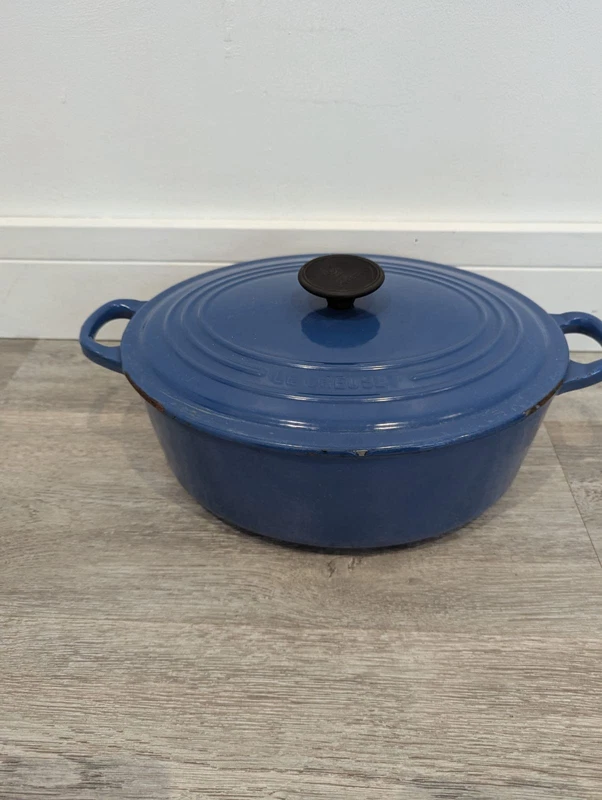
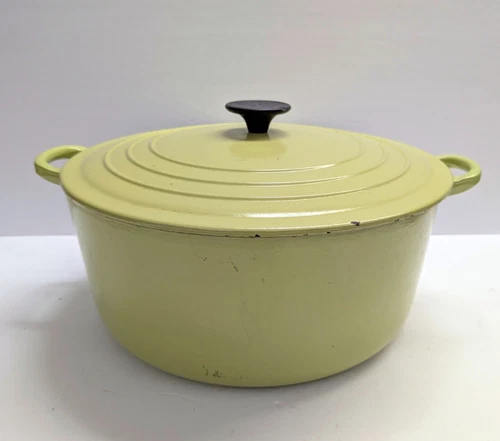
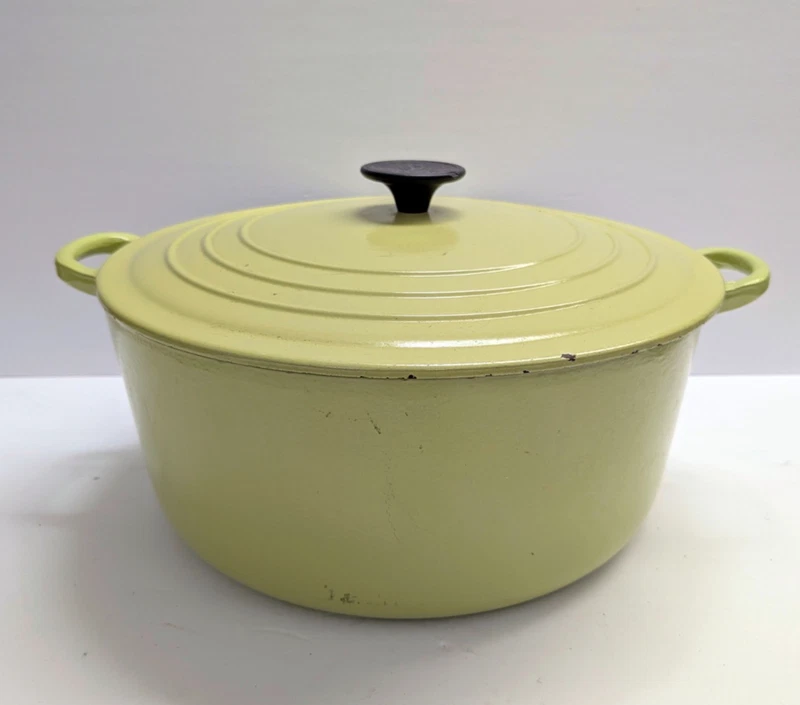
Enamel damage is the failure mode that matters, and the used listings are refreshingly blunt about it. A used was listed at $47.21 with the seller stating the enamel comes away from the side and is worn to the inner bottom. A used was listed at $54.99 as having chips, sold as-is with no returns. A used at $79.99 is described as fully cleaned, in good overall condition, with minor signs of use and some chips in the enamel on the bottom.
Chips on the base are cosmetic. Chips at the rim or on the inner cooking surface are not. That single distinction is the most useful thing to carry into a used purchase, and it is the reason a $47.21 Le Creuset with worn inner enamel is a bargain and a $84.95 one with a clean interior is a better one.
6. Price, new and used
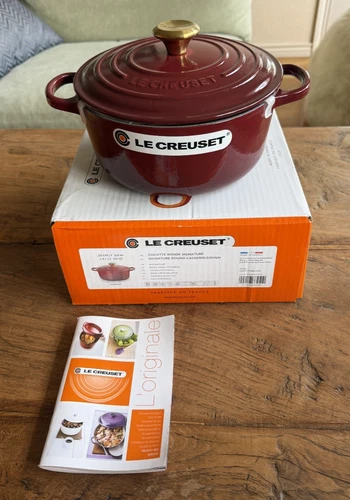
New, the two overlap with a real gap. New Le Creuset we found: $349.89 for the 5.5-quart Flame round, $304.99 for the 4.5-quart Chambray Blue, $296.81 for a retired Mimosa Yellow plate, $155.00 for a 4.25-quart. New Staub we found: a at $251.09, a 4-quart matte black cocotte with no box at $249.99, a cerise oval with a self-basting lid at $220.00, a 3.9-quart round with glass lid at $199.96, a 4-quart cherry round at $194.99, a 1.5-quart French white rice pot at $169.00, a 2.75-quart cherry round with no box at $150.00, and a 4-quart with glass lid at $140.00.
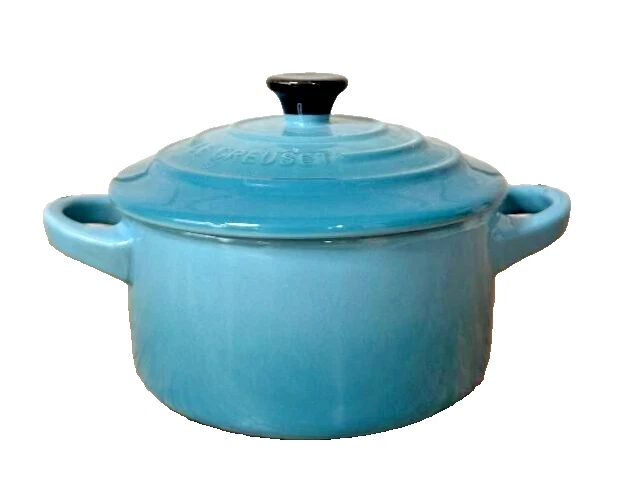
Used, the picture inverts for Le Creuset. Vintage and used Le Creuset pieces appeared at $139.95, $84.95, $49.99, $47.21 and even $34.99 for a new-in-listing , which is a stoneware piece rather than cast iron. Used Staub cocottes we found were $174.99 for a turquoise 4-quart and $149.99 for a red 4-quart, with used pumpkin and lid-only pieces cheaper. Neither brand's used market is cheap, but the entry points differ.





 $84.95