Draft stoppers: the cheapest fix
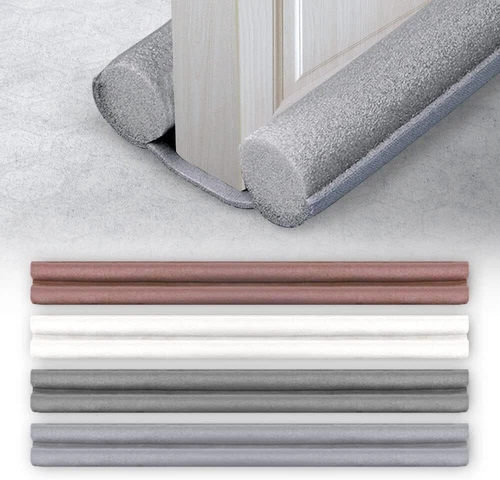
A draft stopper is a strip of foam, often with a fabric or rubber casing, that you push or screw into the gap under the door. It works by compressing. When the door opens it squashes and springs back; when it closes it fills the gap.
This is the right answer when the gap is small and the floor is level. The is the simplest version, at a price that makes it an obvious first thing to try. It also does a genuinely good job on noise, because a tight strip blocks sound as well as air.
The limitation is obvious once you meet it: foam cannot fill a large gap, and on an uneven floor it either leaves a gap or drags. If your door has more than about 10mm underneath, you need something else.
Under-door seals: foam with a hard backing
An under-door seal is a refinement on the same idea. The foam sits in a rigid or semi-rigid carrier that screws or slides into the door itself rather than sitting on the floor, which means it stays correctly positioned as the door opens and closes and it looks tidier.
The is a good example, with the twin profile giving more contact area than a single strip. If you can only fit one thing, this is the most versatile option for a standard internal door.
Door sweeps: hanging brush or rubber
A door sweep hangs from the bottom of the door and rests against the floor or threshold. Because it hangs, it flexes to follow uneven surfaces and it can seal a much larger gap than foam.
Brush seals are quieter because the bristles compress rather than sliding. Rubber sweeps seal better against wind and rain but can be noisier on some floors. The is the durable choice for a door that gets used hard, and the is the typical choice for a standard front or back door.
For an exterior door on a step, a is the correct product. The expander compresses as the door closes, which is what makes it work on a threshold that is not perfectly smooth.
Thresholds: sealing the gap between two surfaces
A threshold seal does a different job. It seals where the door lands, rather than under the door itself — the strip on a step, or the sill between a tiled hallway and a wooden room. If you can feel a line of cold air across a step rather than under a door, this is the product you need.
The is a typical example. A related product worth knowing about is the , which is sold in lengths and is a much larger job than any interior door.
If your draught is coming from a sliding door, none of the above is the right answer. Sliding doors cannot take a sweep that hangs, and the seal runs vertically down the overlap between the two panels.


 $6.99


